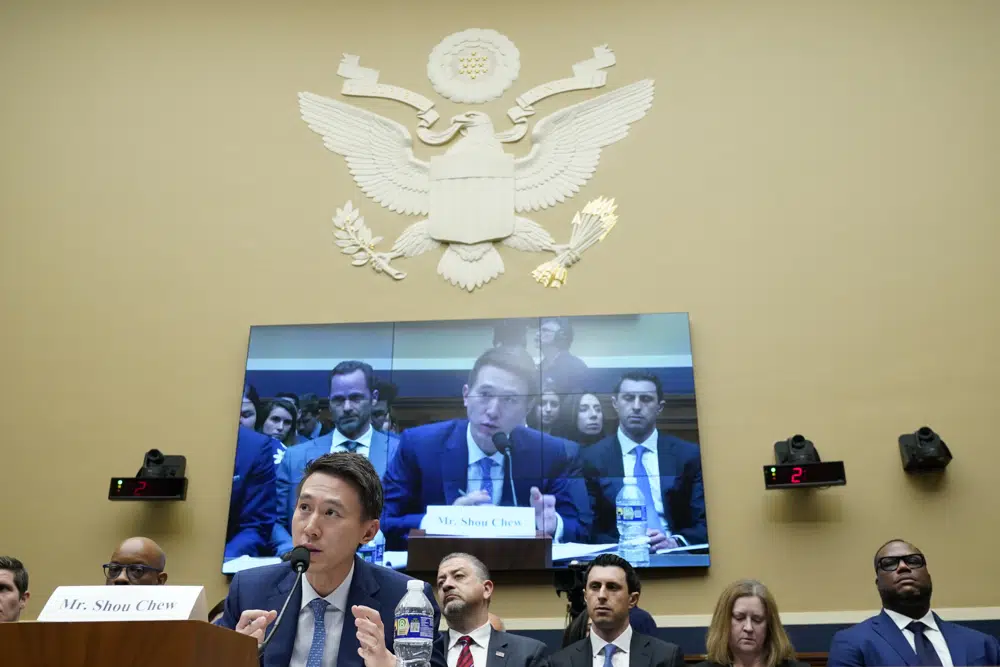
BEIJING (AP) — U.S. lawmakers have grilled TikTok CEO Shou Zi Chew about data security and harmful content, with some pushing to ban the popular short-video app nationwide.
Chew, a native of Singapore, told the lawmakers that TikTok prioritizes user safety as he sought to avert a U.S. ban on the app by downplaying its ties to China.
Both Republican and Democratic representatives aggressively questioned Chew on topics including TikTok’s content moderation practices, its data security plans, and past spying on journalists.
Here’s a look at some of the concerns about TikTok and its ownership.
WHY DOES WASHINGTON SAY TIKTOK IS A THREAT?
TikTok, which has over 150 million American users, is a wholly owned subsidiary of Chinese technology firm ByteDance Ltd., which appoints its executives.
ByteDance is based in Beijing but registered in the Cayman Islands, as is common for privately owned Chinese companies. Its headquarters is in Beijing’s northwestern Haidian district, home to key universities and a hub for tech startups. TikTok has dual headquarters in Singapore and Los Angeles.
Founded by Chinese entrepreneur Zhang Yiming in 2012, ByteDance is said to be valued at around $220 billion — nearly half of its 2021 valuation of $400 billion. Publicly traded Chinese tech companies and privately held ones like ByteDance have plunged in value since the ruling Communist Party tightened control over the industry with anti-monopoly and data security crackdowns.
Western governments worry Chinese authorities could force ByteDance to hand over TikTok data on American users, exposing sensitive information. Foreign Ministry spokeswoman Mao Ning said Friday that China’s government has never and will not ask companies to “collect or provide data, information or intelligence” held in foreign countries, adding the U.S. “has not provided any evidence so far to prove that TikTok threatens U.S. national security.”
ByteDance says 60% of its shares are owned by non-Chinese investors such as U.S investment firms Carlyle Group and Kohlberg Kravis Roberts and Japan’s SoftBank Group. Employees own 20% and its founders the remaining 20%.
Some details of the relationship between TikTok and ByteDance remain unclear to outsiders.
WHAT CHINESE RULES WORRY WESTERN GOVERNMENTS?
China’s 2017 National Intelligence Law states that “any organization” must assist or cooperate with state intelligence work while a separate 2014 Counter-Espionage Law says “relevant organizations … may not refuse” to collect evidence for an investigation.
Since ByteDance, which owns TikTok, is a Chinese company, it would likely have to abide by these rules if Chinese authorities asked it to turn over data.
Laws and regulations are only one aspect of the Communist Party’s pervasive control. There are no legal limits on the party’s powers. The authorities also can threaten to cancel licenses, conduct regulatory or tax investigations and use other penalties to compel compliance by Chinese and foreign companies operating in China.
The party sometimes conveys orders using “window guidance,” or informal communication in private. It has used crackdowns to tighten control over technology companies and force them to align with its goals.
The Chinese government has also sought more direct control over companies by getting seats on boards of directors.
MUST TIKTOK TURN OVER DATA IF THE CHINESE GOVERNMENT SAYS SO, EVEN WITH “ PROJECT TEXAS?”
TikTok has promised to protect data on American users by storing it on servers operated by an outside contractor, Oracle Corp., in what’s known as “Project Texas.” Chew, the TikTok CEO, said all new U.S. user data is stored in the United States and the company should finish deleting older U.S. data from non-Oracle servers this year.
The fear is that ByteDance would have to hand over information it obtained from TikTok if ordered to do so by Chinese authorities, but Chew has said Project Texas will put U.S. data out of China’s reach.
ByteDance disclosed in December that four employees gained access to data about reporters and people connected to them while looking for how information about the company was leaked. Chew told the lawmakers China-based ByteDance employees may still have access to some U.S. data but that won’t be the case once Project Texas is complete.
In November, TikTok’s head of privacy for Europe said some employees in China had access to information about users in Britain and the European Union.
DOES THE COMMUNIST PARTY HAVE ANY INFLUENCE ON BYTEDANCE?
In Thursday’s hearing, lawmakers repeatedly tried to pin down Chew on whether ByteDance had links to China’s communist rulers.
He deflected questions about whether staff and top executives are Communist Party members.
“I do know that the founder himself is not a member of the Communist Party, but we don’t know the political affiliation of our employees because that’s not something we ask,” Chew said.
When questioned whether ByteDance was effectively controlled by the Chinese Communist Party, Chew said he disagreed.
After a lawmaker said the Communist Party holds a “golden share” in ByteDance that allows it to control one ByteDance board seat, Chew said, “That’s not correct.”
In China, so-called golden shares held by official investment funds are one way for Beijing to gain more oversight over business by giving them a 1% stake in companies.
Chew pushed back when lawmakers claimed that the Communist Party owns shares in ByteDance that give it a vote in how the company is run. “The Communist Party doesn’t have voting rights in ByteDance,” Chew said.
ByteDance’s main Chinese subsidiary is the license-holder for some of its video and information platforms that only serve the China market.
WHAT IS DOUYIN AND WHAT IS TIKTOK’S RELATIONSHIP WITH IT?
Douyin is ByteDance’s short-video platform for the China market. It’s similar to TikTok, but its content is restricted by Chinese censorship rules that prohibit material deemed subversive or pornographic – a point emphasized by U.S. lawmakers worried about harmful content viewed by young people.
The Communist Party’s extensive internet filters block most users in China from seeing TikTok. ByteDance has said TikTok has “no affiliation” with Beijing ByteDance Technology Co., the subsidiary that operates Douyin; Toutiao, a news and short-video platform, and other services.
HOW DID CHINA REACT TO THE TIKTOK CEO’S WASHINGTON TESTIMONY?
Most of the social media reaction in China was sympathetic to Chew, with praise for how he handled the hostile questions lobbed at him.
Comments on Douyin and microblogging platform Weibo were critical of U.S. lawmakers for asking Chew leading or “trap” questions. Many commenters used a Chinese saying that means “If you want to accuse someone, there’s always a way.”


