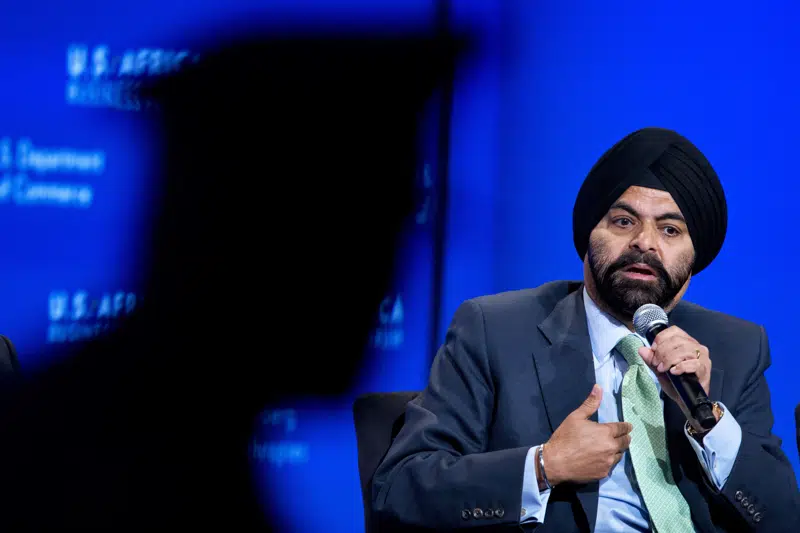
BENGALURU, India (AP) — The incoming president of the World Bank was born in India and forged his early business success there, a fact supporters say gives Ajay Banga valuable insight into the challenges faced by the developing countries the bank is supposed to help.
But not everyone is sure that Banga, who has spent most of the last two decades in the U.S. corporate world, can be counted on to shake up the bank in the way some think it should be.


U.S. Treasury Secretary Janet Yellen talked up Banga’s credentials this week on the sidelines of the World Bank and International Monetary Fund’s spring meetings in Washington. Banga, currently vice chairman at private equity firm General Atlantic, has more than 30 years of business experience, including as CEO of Mastercard and on the boards of the American Red Cross, Kraft Foods and Dow Inc.
“He has the right leadership and management skills, background, and financial expertise to lead the World Bank at a critical moment in its history,” Yellen said.
That came after President Joe Biden, in nominating Banga in February, heralded his “critical experience” dealing with urgent world challenges like climate change, even though his resume shows little to do with climate credentials.
The World Bank — the world’s largest and oldest development bank — includes 189 member countries with a mission to reduce poverty and build prosperity in the developing world. The threat of climate change is a major focus, with the bank billing itself as the largest financier of climate action in developing countries.
But leaders and activists from poorer nations, especially those vulnerable to the extreme weather made worse by climate change, have called for massive reforms in the entire multinational development bank system. Led by Barbados Prime Minister Mia Mottley and embraced by French President Emmanuel Macron, they have pushed something called the Bridgetown Initiative, which would make it easier and faster for developing countries hit by weather disasters to get money with lower interest rates for both recovery and for building to be more resilient.
Mottley tweeted a photo of herself and Banga from a March 11 meeting, saying the two had discussed the Bridgetown Initiative and how the World Bank “can be responsive to helping save the planet, while easing the burden on the most vulnerable.” France has also indicated support for Banga.
Banga will replace David Malpass, a Donald Trump appointee who announced he would step down this June, a year early, after coming under pressure for declining to say whether he agreed with scientific consensus on climate change.
Climate finance analysts are relieved that Banga at least believes climate change is caused by fossil fuels. But many are skeptical that his experience — which includes stints at Nestle, Pizza Hut and Mastercard — is a natural fit for climate finance. And while he comes from a climate-stressed state in India, a nation that’s simultaneously battling growing energy demands and climate change effects, his long career in America adds to their wait-and-see attitude.
Anit Mukherjee, a senior fellow at the Observer Research Foundation America, a think tank devoted to India’s global development, called Banga’s ascension “a proud moment for India.”
“Growing up in India, Banga will likely understand the issues developing countries face. It is also clear he understands markets around the world,” said Mukherjee, who has worked closely on reforming multilateral development banks. “Whether he will understand the challenges of climate financing and development is still unclear.”
Harjeet Singh, head of global political strategy at Climate Action Network International, called Malpass’s departure a historic opportunity to “change the system.” But Banga is just old wine in a new bottle, Singh said.
“He has worked in corporations whose prime motive is profit. When it comes to development, especially climate change, it is about justice and equity,” said Singh. Banga’s background “doesn’t inspire confidence,” he said.
“We are facing multiple crises including climate change, the debt crisis, and the banking crisis. We cannot continue with the same systems that are responsible for these crises,” said Singh.
Luiz Vieria, coordinator of the Bretton Woods Project, which watchdogs the World Bank and the International Monetary Fund, lamented as unfair the tradition by which the U.S. typically appoints the World Bank head and Europe appoints the IMF head. Banga “doesn’t even meet the bare bones criteria,” he said.
The son of an Indian army officer, Banga was born in 1959 and educated in some of India’s premier institutions. When India’s economy liberalized in the early ’90s, Banga was able to work and rise through the ranks of multinational corporations breaking into India.
Since moving to the U.S. in the early 2000s, Banga has held prestigious positions in the corporate world, including heading Mastercard and serving as director of Exor and Temasek, large holding companies whose portfolios are diverse and include media companies such as Mediacorp and the Economist as well as automobile companies like Ferrari.
“Appointing someone like Banga is a great way to open the conversation with developing countries,” said Suranjali Tandon, an assistant professor at the National Institute of Public Finance and Policy, a research institute affiliated to the Indian government.
But Tandon wondered whether Banga will be able or willing to drastically change how the World Bank works.
“His private sector experience makes him well versed with taking high risks and getting high returns,” she said.
“Development finance, especially climate finance though, is about high risk and low return investments. Given this, I don’t see the World Bank radically transforming under his leadership.”