WASHINGTON (AP) — A divided federal appeals court on Monday ruled that private individuals and groups such as the NAACP do not have the ability to sue under a key section of the federal Voting Rights Act, a decision that contradicts decades of precedent and could further erode protections under the landmark 1965 law.
The 2-1 decision by a panel of the 8th Circuit Court of Appeals based in St. Louis found that only the U.S. attorney general can enforce Section 2 of the Voting Rights Act, which requires political maps to include districts where minority populations’ preferred candidates can win elections.
The majority said other federal laws, including the 1964 Civil Rights Act, make it clear when private groups can sue but said similar wording is not found in the voting law.
“When those details are missing, it is not our place to fill in the gaps, except when ‘text and structure’ require it,” U.S. Circuit Judge David R. Stras wrote for the majority in an opinion joined by Judge Raymond W. Gruender. Stras was nominated by former President Donald Trump and Gruender by former President George W. Bush.
The decision affirmed a lower judge’s decision to dismiss a case brought by the Arkansas State Conference NAACP and the Arkansas Public Policy Panel after giving U.S. Attorney General Merrick B. Garland five days to join the lawsuit.
Chief Judge Lavenski R. Smith noted in a dissenting opinion that federal courts across the country and the U.S. Supreme Court have considered numerous cases brought by private plaintiffs under Section 2. Smith said the court should follow “existing precedent that permits a judicial remedy” unless the Supreme Court or Congress decides differently.
“Rights so foundational to self-government and citizenship should not depend solely on the discretion or availability of the government’s agents for protection,” wrote Smith, another appointee of George W. Bush.
Sophia Lin Lakin, director of the ACLU’s Voting Rights Project, called the ruling a “travesty for democracy.” She had argued the appeal on behalf of the two Arkansas groups.
“By failing to reverse the district court’s radical decision, the Eighth Circuit has put the Voting Rights Act in jeopardy, tossing aside critical protections that voters fought and died for,” Lakin said in a statement.
It was not immediately clear whether the groups would appeal. A statement from the ACLU said they are exploring their options.
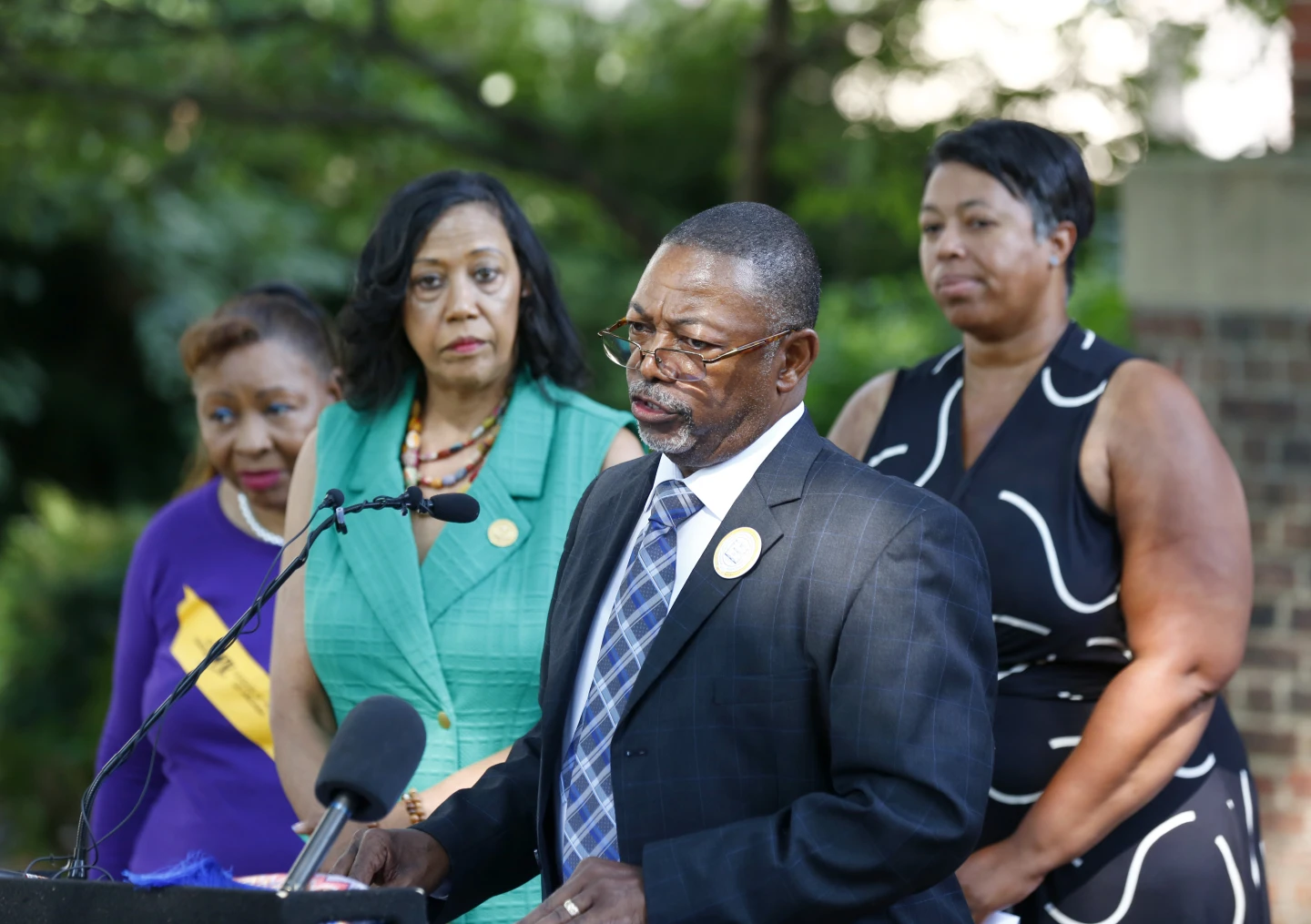
Barry Jefferson, political action chair of the Arkansas State Conference of the NAACP, called the ruling “a devastating blow to the civil rights of every American, and the integrity of our nation’s electoral system.”
The state NAACP chapter and the public policy group had challenged new Arkansas state House districts as diluting the influence of Black voters. The state’s redistricting plan created 11 majority-Black districts, which the groups argued was too few. They said the state could have drawn 16 majority-Black districts to more closely mirror the state’s demographics.
U.S. District Judge Lee Rudofsky noted there was “a strong merits case that at least some of the challenged districts” in the lawsuit violate the federal Voting Rights Act but said he could not rule after concluding a challenge could only be brought by the U.S. attorney general.
The Justice Department filed a “statement of interest” in the case saying private parties can file lawsuits to enforce the Voting Rights Act but declined to comment on the ruling.
Monday’s ruling applies only to federal courts covered by the 8th Circuit, which includes Arkansas, Iowa, Minnesota, Missouri, Nebraska, North Dakota and South Dakota. Meanwhile, several pending lawsuits by private groups challenge various political maps drawn by legislators across the country.
It’s likely the case eventually will make it to the U.S. Supreme Court, where the issue was raised in a 2021 opinion by Justice Neil Gorsuch.
“I join the court’s opinion in full, but flag one thing it does not decide,” Gorsuch wrote at the time, joined by Justice Clarence Thomas. “Our cases have assumed — without deciding — that the Voting Rights Act of 1965 furnishes an implied cause of action under section 2.”
Gorsuch wrote that there was no need in that case for the justices to consider who may sue. But Gorsuch and Thomas were among the dissenters in June when the Supreme Court ruled 5-4 in another Voting Rights Act case in favor of Black voters in Alabama who objected to the state’s congressional districts.
The Gorsuch and Thomas opinion was referenced less than two weeks ago in another federal court decision that came to the opposite conclusion of Monday’s ruling by the St. Louis-based court.
On Nov. 10, three judges on the conservative-dominated 5th U.S. Circuit Court of Appeals in New Orleans rejected arguments that there is no private right to sue under the Voting Rights Act. In a Louisiana congressional redistricting case, the panel said the U.S. Supreme Court so far has upheld the right of private litigants to bring lawsuits alleging violations of Section 2, as have other circuit appellate courts.
Fifth Circuit Judge Leslie Southwick, a nominee of George W. Bush, pointed to separate cases from 1999 and 2020 that reaffirmed that right.
Election law experts say most challenges seeking to enforce Section 2 of the Voting Rights Act are brought by private plaintiffs and that the Justice Department has limited resources to pursue such cases. Some voting rights experts also noted the apparent contradiction in the Alabama case decided by the Supreme Court last June and Monday’s ruling by the appellate court.
“It doesn’t seem to make sense,” said Jon Greenbaum, chief counsel for the Lawyers’ Committee for Civil Rights Under Law. “If the laws were that private parties couldn’t bring these cases, then the Alabama case would have never even gotten off the ground.”
Lawsuits under Section 2 have long been used to try to ensure that Black voters have adequate political representation in places with a long history of racism, including many Southern states. Racial gerrymandering has been used in drawing legislative and congressional districts to pack Black voters into a small number of districts or spread them out so their votes are diluted. If only the U.S. attorney general is able to file such cases, it could sharply limit their number and make challenges largely dependent on partisan politics.
It’s unlikely Congress will be willing to act. Republicans have blocked recent efforts to restore protections in the Voting Rights Act that were tossed out by the U.S. Supreme Court a decade ago. In the 2013 Shelby v. Holder decision, justices dismantled an enforcement mechanism known as preclearance, which allowed for federal review of proposed election-related changes before they could take effect in certain states and communities with a history of discrimination.
In a statement, the Congressional Black Caucus noted that private individuals and civil rights groups have been successful in giving Black voters better representation through recent challenges to congressional maps drawn by Republican lawmakers in Alabama, Louisiana and Florida.
“This decision by the appellate court is ill-advised, cannot stand, and should be appealed to the U.S. Supreme Court, which we hope will reaffirm that citizens have a private right of action to bring forward lawsuits under Section 2,” the group said.