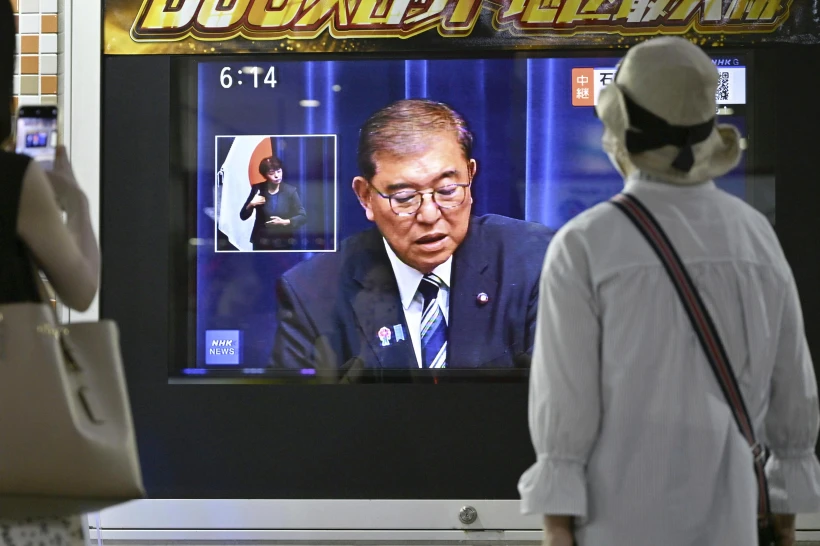
TOKYO (AP) — The jockeying for a new prime minister began on Monday as outgoing Prime Minister Shigeru Ishiba’s beleaguered long-governing Liberal Democratic Party struggles to stay in office as Japan faces challenges such as U.S. tariffs, an increasingly assertive China and growing populism at home.
On Sunday, Ishiba announced that he would resign as head of the LDP and eventually prime minister to take responsibility for the historic loss in the summer parliamentary election, making way for his successor to be chosen in a party leadership race now expected in early October.
The party wrangling and Ishiba’s departure after just one year in office underscores Japan’s political uncertainty.
Next step
Ishiba’s resignation announcement Sunday aborted plans by the LDP to decide on whether to hold an early leadership election, which effectively would have been a no-confidence vote in him. The move by Ishiba paves the way for a leadership race, which is now expected on Oct. 4.
Party officials started discussing the upcoming race and were expected to finalize details Tuesday.
They have an option of either a “full-spec” vote that includes both LDP lawmakers and local rank-and-file representatives, as in the previous race, or a simplified vote without a broader membership of local chapters. Officials were reportedly considering the full version.
In order to enter the race, a candidate must collect nominations from 20 fellow LDP parliamentarians.
Possible candidates
Toshimitsu Motegi, a centrist former foreign minister and LDP ex-secretary-general, was the first to raise his hand on Monday, saying he has decided to run “to devote all of myself to the country.”
Other likely contenders are Agriculture Minister Shinjiro Koizumi, the son of popular former Prime Minister Junichiro Koizumi; Chief Cabinet Secretary Yoshimasa Hayashi, a moderate close aide to former Prime Minister Fumio Kishida; Sanae Takaichi, an ultraconservative former economic security minister who was backed by late former leader Shinzo Abe; and Takayuki Kobayashi, another ultraconservative who has also served as economic security chief. They also ran in the race last year.
Takaichi saw many of her previous nominees lose their seats in the past two elections because of their links to corruption scandals, and may have trouble fulfilling the candidacy requirement, some experts say.
Unlike the era when the LDP dominated parliament, its governing coalition’s lack of a majority in both houses requires it to find a new leader who can cooperate with main opposition parties that are more to the center, says Masato Kamikubo, a political science professor at Ritsumeikan University.
On Monday, Tetsuo Saito, leader of LDP junior coalition partner Komeito, told reporters that his party can’t stay in the coalition unless a new leader is center-right.
Challenges for a new leader
As Ishiba noted Sunday, Japan faces challenges such as growing tension from China, North Korea and Russia, U.S. President Donald Trump administration’s tariffs and other demands, including increased defense spending and purchases of U.S. weapons, rising prices at home, rice policy reforms, an aging and shrinking population and growing attention on immigration policies.
Those challenges will be handed over to his successor. The party also faces the rise of new populist groups such as Sanseito that gained ground on populist platforms.
“It’s essential for a next prime minister to form a consensus (with the opposition) in dealing with diplomacy, Trump and China,” Kamikubo said. “If this can be done, I don’t think Japan’s political outlook is not so bleak. It’s easy to say it’s getting worse and unstable, but I don’t think it has to be that way.”